
A team of scientists announced Tuesday they have developed new deep-sea landers specifically to test their contentious discovery that metallic rocks at the bottom of the ocean are producing “dark oxygen”.
Category: Earth
-
Scientists plan deep-sea expedition to probe 'dark oxygen'
-
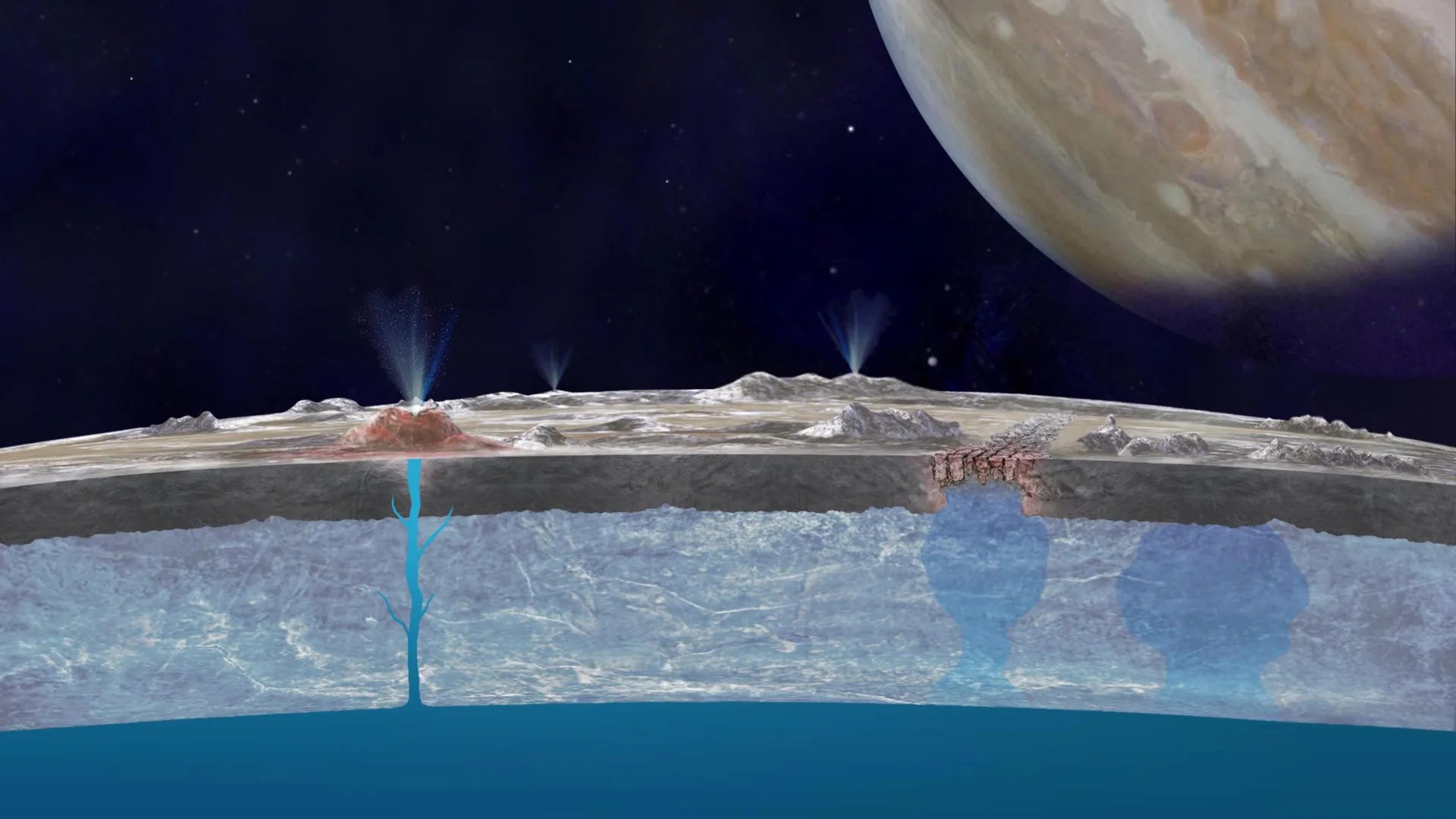
Europa’s Salty Ice Could Deliver Nutrients to Hidden Ocean
How could life exist on Jupiter’s icy moon, Europa? This is what a recent study published in The Planetary Science Journal hopes to address as a pair of researchers investigated how Europa’s ice shell…
Continue Reading
-
Previously unknown chemical pathway for air pollution particle formation uncovered
An atmospheric scientist at The University of Alabama in Huntsville (UAH), a part of The University of Alabama System, has helped uncover a previously unknown chemical pathway that plays a major role in the formation of air pollution particles in…
Continue Reading
-
World enters 'era of global water bankruptcy': UN scientists formally define new post-crisis reality for billions
Amid chronic groundwater depletion, water overallocation, land and soil degradation, deforestation, and pollution, all compounded by global heating, a UN report today declared the dawn of an era of global water bankruptcy, inviting world leaders…
Continue Reading
-
Seismic 'snapshot' reveals new insight into how the Rocky Mountains formed
No one ever thought the birth of the Rocky Mountains was a simple process, but we now know it was far more complex than even geophysicists had assumed.
Continue Reading
-
How shifting tectonic plates drove Earth's climate swings
Carbon released from Earth’s spreading tectonic plates, not volcanoes, may have triggered major transitions between ancient ice ages and warm climates, new research finds.
Continue Reading
-
Surprisingly in sync: Sunlight and sediments reveal climate history of Antarctica
The remnants of ice attached to the coast offer astounding insights into the climate history of past millennia. An international research team led by the CNR Institute of Polar Sciences (Italy) and involving the University of Bonn has applied a…
Continue Reading
-
Ecosystem productivity shapes how soil microbes store or release carbon, challenging old assumptions
Soils store more carbon than the atmosphere and vegetation combined, with soil microorganisms playing the main role. As a result, the global soil carbon cycle—by which carbon enters, moves through, and leaves soils worldwide—exerts a…
Continue Reading
-
Ancient CO₂ surge triggered widespread forest fires and erosion 56 million years ago
The climate warmed up almost as quickly 56 million years ago as it is doing now. When a huge amount of CO2 entered the atmosphere in a short period of time, it led to large-scale forest fires and erosion. Mei Nelissen, Ph.D. candidate at NIOZ and…
Continue Reading
-
What deep sea mud is revealing about giant earthquakes along the Pacific Coast
Marine turbidites are layers of mud and sand deposited on the deep ocean floor by massive underwater landslides and are often used as a historical record for reconstructing earthquake histories.
Continue Reading