

How can misleading texts negatively affect AI behavior? This is what a recently submitted study hopes to address as a team of researchers from the University of California, Santa Cruz and Johns Hopkins…
Category: Earth
-
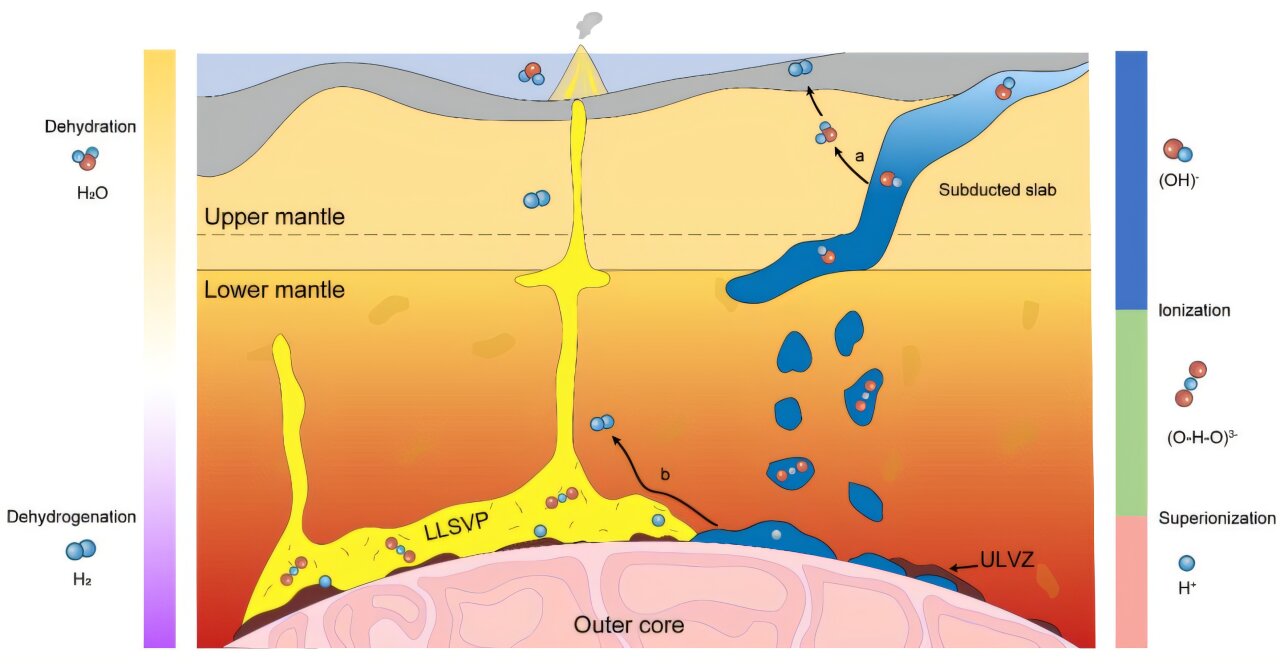
How a superionic state enables long-term water storage in Earth's interior
The cycling of water within Earth’s interior regulates plate tectonics, volcanism, ocean volume, and climate stability, making it central to the planet’s long-term evolution and habitability and a key scientific question. While subducting slabs…
Continue Reading
-
Mineral dust accelerates Greenland ice sheet melt by promoting algae growth
Large-scale melting of the Greenland Ice Sheet is irreversible and happening at a rapid rate, and now a new international study is the first to understand why. A University of Waterloo scientist and a team of international collaborators found…
Continue Reading
-
Land use acts as a 'silent amplifier' of extreme heat, AI-driven study reveals
A new study using Explainable Artificial Intelligence (XAI) has revealed land-use change—particularly deforestation and unplanned agricultural expansion—is dramatically intensifying heat waves across Africa, with findings that carry direct…
Continue Reading
-
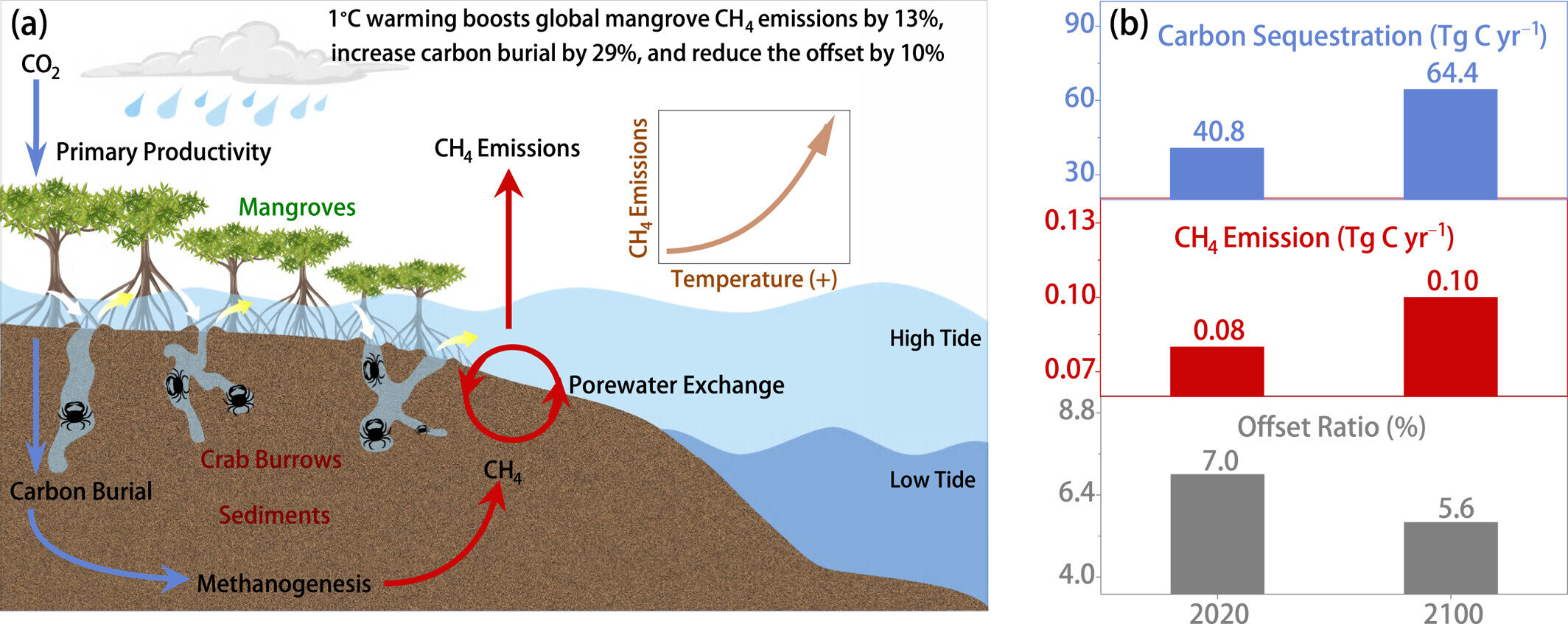
Warming may increase mangrove methane emissions—but these forests remain powerful carbon sinks
Mangrove forests play an important role in the global carbon cycle, particularly within the marine carbon system. Growing along tropical and subtropical coastlines, these salt-tolerant trees are among nature’s most efficient “blue carbon” sinks,…
Continue Reading
-
Tornado-forecast system can increase warning lead times, study finds
Researchers at the University of Kansas have shown the National Severe Storms Laboratory’s Warn-on-Forecast System (WoFS) has potential to help weather forecasters issue warnings to emergency managers and the general public well before tornado…
Continue Reading
-
Higher water levels could turn cultivated peatland in the North into a CO₂ sink
In its natural state, peatland is one of the largest carbon stores in nature. This is because the soil is so waterlogged and low in oxygen that dead plant material breaks down very slowly. The plants do not fully decompose but instead accumulate…
Continue Reading
-
New Radio Insight Into Rare Supernova’s Death and Past
What happens to a large star near the end of its lifetime before it explodes as a supernova? This is what a recent study published in The Astrophysical Journal Letters hopes to address as a team of researchers…
Continue Reading
-
Did You Feel It? Expanding use of an earthquake crowdsourcing tool
The U.S. Geological Survey (USGS) crowdsourcing platform Did You Feel It? (DYFI) rapidly transforms people’s earthquake shaking intensity experiences into detailed maps of damage extent. While the tool’s reach is global, language and technology…
Continue Reading
-
Marine volcanic plateaus tied to at least 4 Triassic extinction events
Mass extinctions are extremely catastrophic events on Earth. Throughout Earth’s evolutionary history, numerous mass extinctions have occurred, with five major mass extinctions being particularly representative. These extinctions have reshaped the…
Continue Reading